# Scopes

Scopes define what resources an application can access via an API.\
In OAuth 2.0, they manage permissions and enhance security.\
\
As part of your onboarding, we will determine the appropriate scope for your business.

## Usage of Scopes

1. **Access Control**: Limit access to resources, e.g., `FUSESIGN:OWN`.
2. **Granularity**: Offer different access levels.
3. **Authorization**: Users consent to requested scopes.
4. **Token Enforcement**: Tokens carry scopes to restrict access.

Scopes ensure applications request only necessary permissions, improving security and user trust.

## Available Scopes

FuseSign has the following available Scopes

<table><thead><tr><th width="212">Scope Name</th><th>Access</th></tr></thead><tbody><tr><td>FUSESIGN:OWN</td><td><p>Only permits actions against the business and may modify any resources they have created.</p><p><br>✅ can create bundles, upload documents and perform actions on any bundles where they are the creator of that bundle.</p><p></p><p>❌ cannot perform other API actions for example modify bundles that are not theirs or perform contact or bundle search operations.</p></td></tr><tr><td>FUSESIGN</td><td>Permits actions against the business and may modify any resources within it</td></tr></tbody></table>

## Authorization

Users must authorize integrations to be allowed into their account\
\
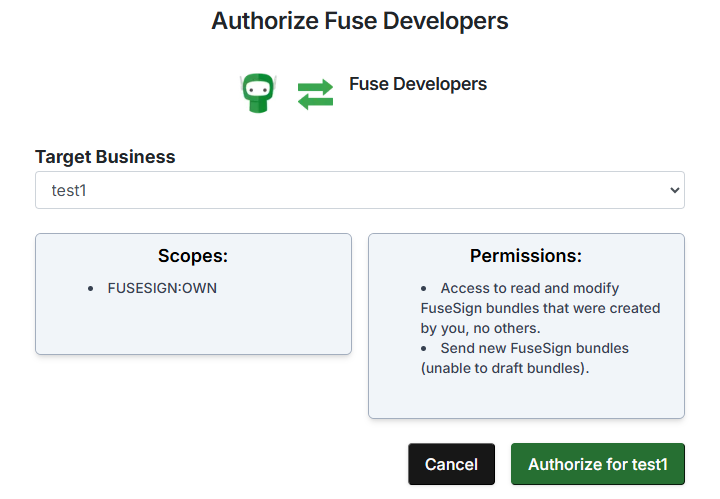
This is how that will appear:\ <br>

<div><figure><img src="/files/Q6Sb3DCDZJ0HAWwWQCob" alt=""><figcaption><p>FUSESIGN:OWN scope</p></figcaption></figure> <figure><img src="/files/pkjQ0tkNtdoJVKtE1xXr" alt=""><figcaption><p>FUSESIGN scope</p></figcaption></figure></div>


---

# Agent Instructions: Querying This Documentation

If you need additional information that is not directly available in this page, you can query the documentation dynamically by asking a question.

Perform an HTTP GET request on the current page URL with the `ask` query parameter:

```
GET https://fuseworks.gitbook.io/fusesign/deep-dives/scopes.md?ask=<question>
```

The question should be specific, self-contained, and written in natural language.
The response will contain a direct answer to the question and relevant excerpts and sources from the documentation.

Use this mechanism when the answer is not explicitly present in the current page, you need clarification or additional context, or you want to retrieve related documentation sections.
